
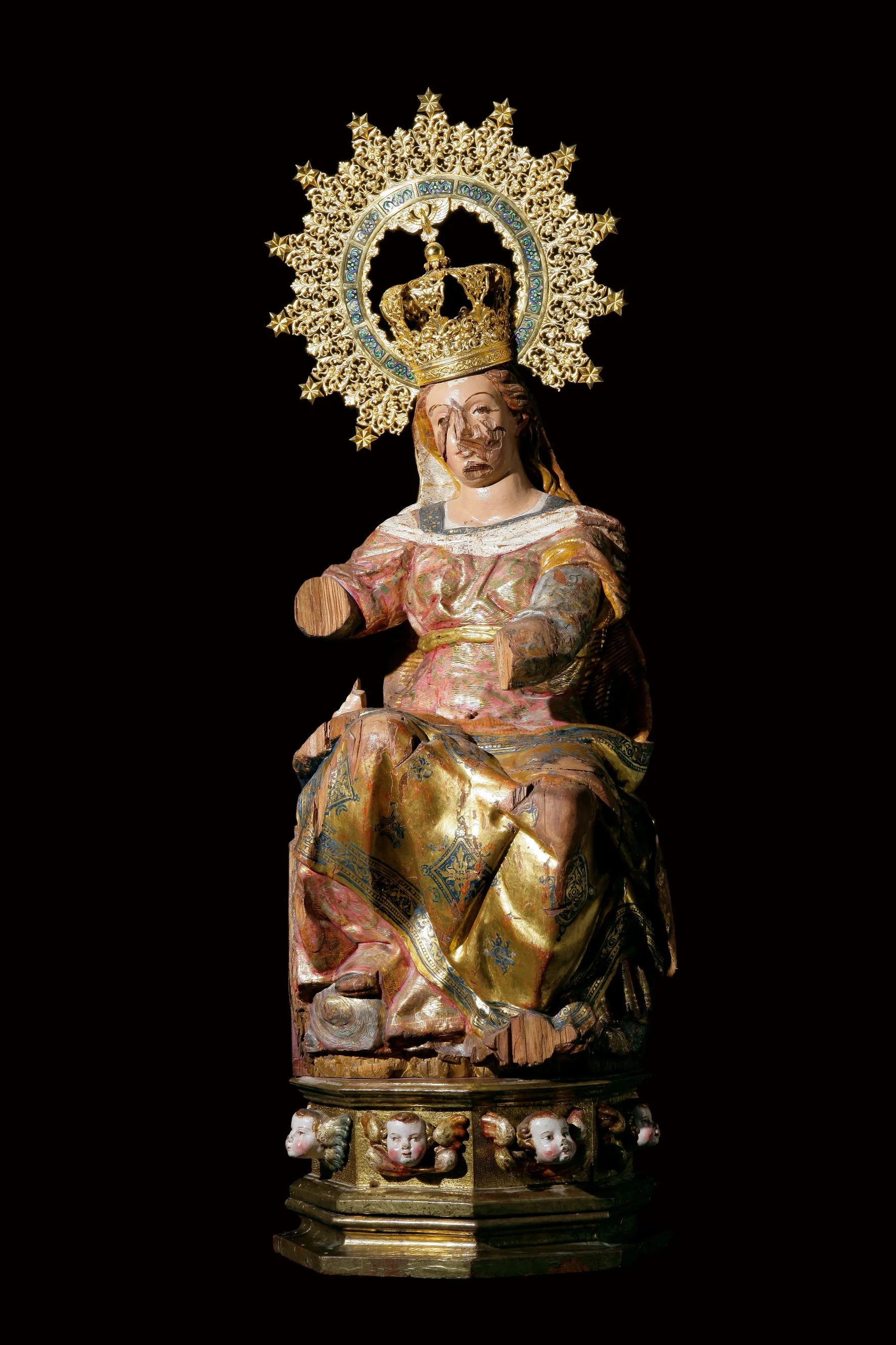
The mother of our college
The extraordinary story of Our Lady Vulnerata
Our Lady Vulnerata is the mother of the college, the mother of our saints and martyrs, and a daily help and protection to those who live alongside her. Generations of students have bowed their heads before the statue each day and sought her intercession. But it might not have been, because of the statue’s extraordinary story.
It begins amid the bloody undeclared war between the kingdoms of England and Spain that erupted towards the end of the sixteenth century and flared up intermittently for the next nineteen years.
The Spanish Armada
In 1588, King Philip II, supported by Pope Sixtus V, sent the first Spanish Armada with the aim of reinstating Catholicism in England by spearheading an attempt to overthrow Protestant Queen Elizabeth I.
In the eight years of conflict that followed, both sides had their military successes but neither was able to claim overall victory. Then, in June 1596, around 14,000 English and Dutch sailors led by the Earl of Essex set sail for the southern port of Cadiz intending to capture the Spanish fleet.
They caught the Spanish unprepared and quickly overcame the little resistance offered before ransacking the city, although at their commanders’ orders they did not touch its citizens.
Ransack of the statue in Cadiz
Some of the English troops dragged a statue of the Virgin Mary and Child Jesus from the cathedral to the market square. There they proceeded to hack off both of Our Lady’s arms with their sabres and slash her face.
By the time the statue was thrown onto a rubbish heap outside the city, all that remained of the infant Jesus were two stumps where his tiny feet has dangled from his mother’s knee.
Abandoned there, she was recovered by the Adelantado (Captain-General) of Castile, the Count of Santa Gadea and his wife. They gave the image place of pride in their chapel in Madrid.
The REC seeks to make amends
In 1600, English College procurator Father John Blackfan approached the Adelantado and his wife and asked for the chance to make reparation for the desecration committed by his fellow countrymen by taking it back to the college with him.
At first they were reluctant to agree to the request, but the students would not give up easily and wrote imploring her to change her mind.
“It is just that the English Catholics should disclaim the injuries which the English heretics have offered to Our Lady, and should serve and reverence the image which they have abused,” they said. “Our respect to it will be greater and more sincere than the irreverence which they manifested to it.”
The countess reluctantly wrote back agreeing to hand over the statue. Before doing so, however, she insisted on having a golden crown, a rich mantle and a veil made to cover Our Lady’s disfigurement.
It was formally received by the canons of the chapter and the clergy and an all-night vigil then took place. After High Mass the next day, September 8, the Feast of the Nativity of Mary, the statue was brought in a solemn procession to the doors of the English College, where a large crowd waited outside.
Margaret of Austria, Queen of Spain, was the first person to see the statue enter the chapel, an encounter described by a contemporary chronicler as a meeting between the “only Queen of Heaven and the only Catholic Queen on earth”. After hymns in Latin and English, the College dined at the Queen’s expense.
After nine days of celebration, the Bishop of Valladolid gave the image the title of Santa Maria Vulnerata (St Mary, the Wounded One). The sorrows she had suffered proved an inspiration to the college students, who faced possible martyrdom after their ordination as priests for the English Mission.
A living tradition
Every week since 1600, the St Alban’s community has prayed in front of Our Lady Vulnerata, offering reparation for the wounds inflicted by the English sailors.
In October 2000, the college celebrated the 400th anniversary of Our Lady Vulnerata’s arrival. Reversing her journey of 1600, she left the chapel in a procession to the city’s cathedral, where Mass was celebrated by the late Archbishop José Delicado Baeza, accompanied by four English bishops, the cathedral chapter and many old boys.
The next day, on the Feast of the Martyrs of the Venerable English College, Mass was celebrated in the college chapel and Our Lady Vulnerata was given a new crown, bought by the college old boys, the Valladolid Association, as a gift.
Each Monday of Holy Week since 2002 she has been carried to the street outside the college for a moving encounter with a statue of her crucified son, Cristo del Olvido, Christ the Forgotten, an event that draws growing crowds each year.
The images below tell the remarkable story of how Our Lady Vulnerata came to the Royal English College. These 1679 paintings by Diego Diez Ferreras adorn the ceiling of the College chapel.
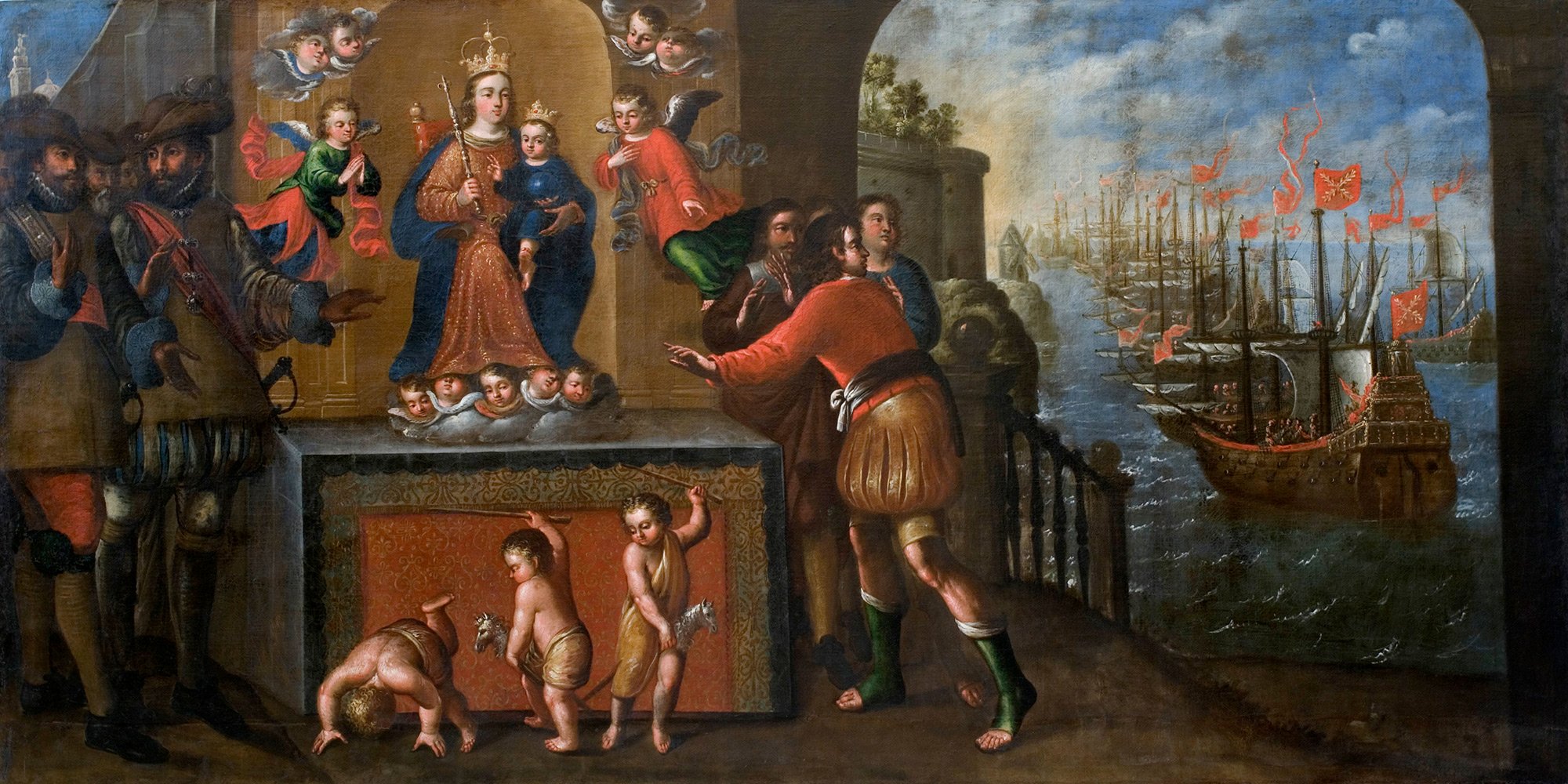
An English and Dutch fleet lands at the Spanish port of Cadiz
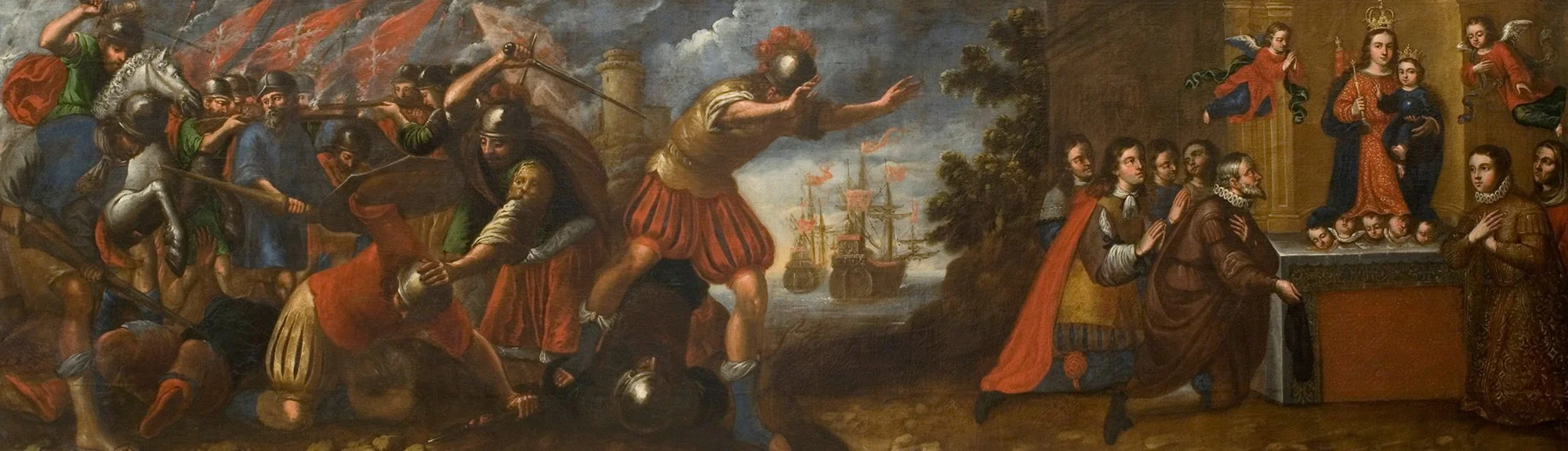
The English and Dutch attackers overcome the little resistance offered, while citizens pray at the feet of a statue of the Virgin Mary and Child Jesus

The attackers pull down the statue of the Virgin Mary
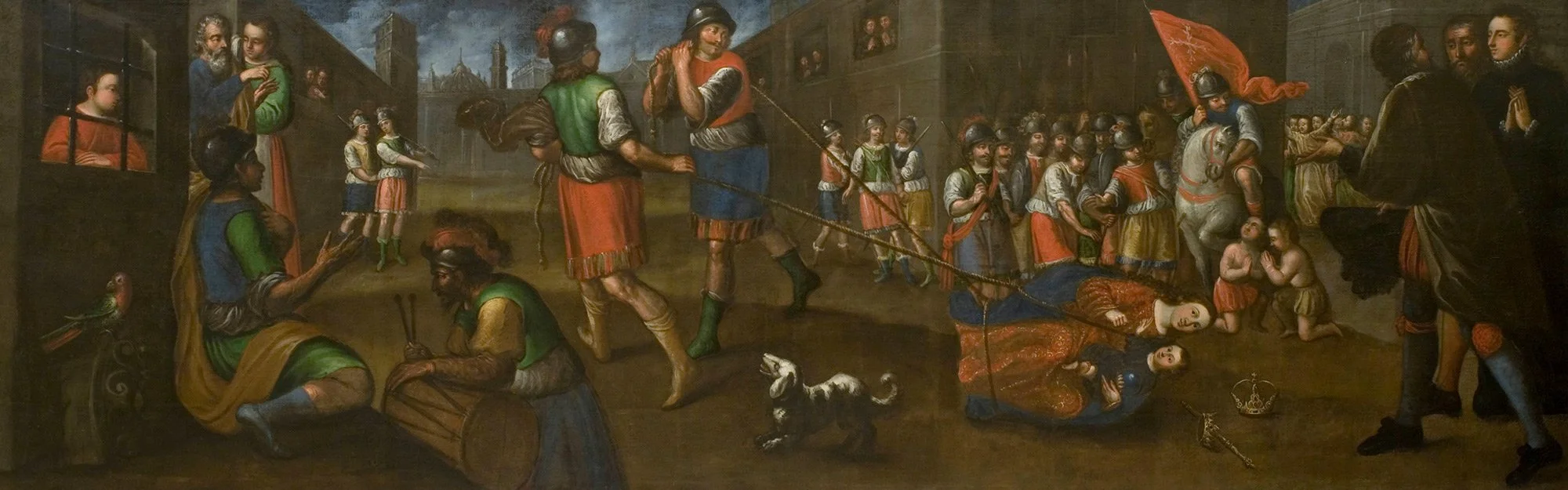
The statue of the Virgin Mary is dragged through the streets to the market square
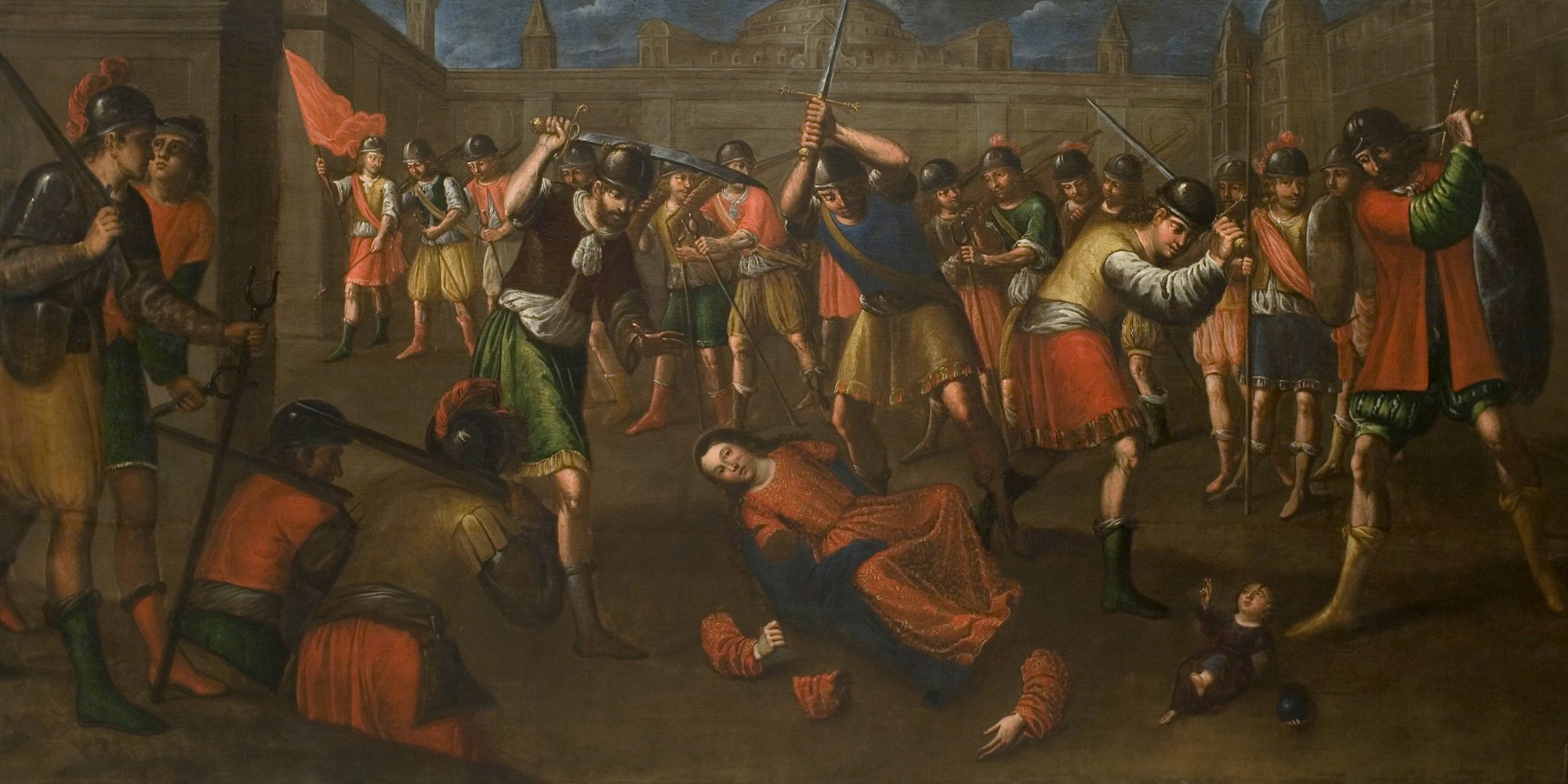
The attackers hack at the statue of the Virgin Mary and Child Jesus, leaving it irreparably damaged
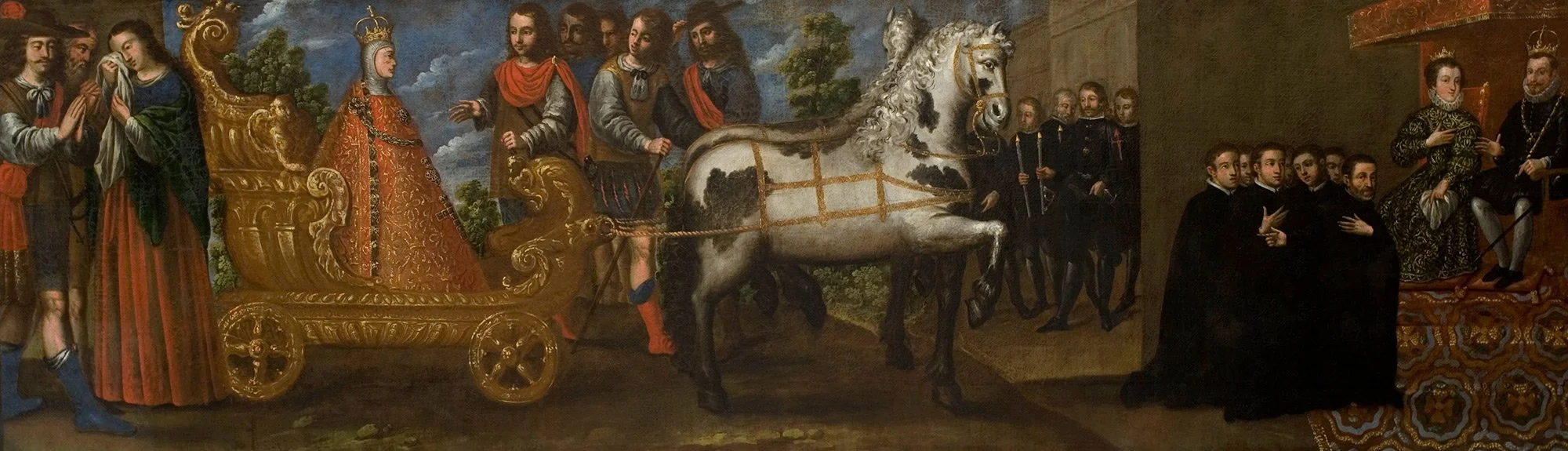
The countess weeps after agreeing to allow the statue to be taken to the Royal English College in Valladolid

Our Lady Vulnerata arrives by procession at the doors of the Royal English College